National donor-advised fund sponsors do a handful of things extremely well: low costs, broad investment menus, and a self-service model that lets donors move quickly with minimal friction. For a certain kind of client, that’s exactly what they want, and there’s no reason to talk them out of it.
But for clients whose giving has become more personal, more local, or more complicated, a community foundation offers something structurally different. It isn’t a better version of the same product. It’s a different kind of relationship, built around knowledge and connections that a national platform was never designed to provide.
Local Knowledge That Actually Shapes Decisions
A national sponsor can tell a donor whether a nonprofit is a registered 501(c)(3) in good standing. It generally can’t tell them whether that nonprofit is well run, whether it duplicates the work of three other groups in the same city, or whether a smaller, less visible organization down the street is quietly doing better work with the same mission.
Community foundation staff spend their careers embedded in one region. They know which organizations have strong leadership and which are struggling, where funding gaps exist that donors haven’t thought to look for, and how different nonprofits in the same space relate to one another. That knowledge turns a donor’s vague sense of “I want to help” into a specific, informed decision about where a gift will do the most good. It’s the difference between searching a database and asking someone who has spent twenty years watching the local nonprofit sector up close.
Personalized Guidance, Not Just Account Access
A national DAF sponsor manages the fund. A community foundation tends to manage the relationship.
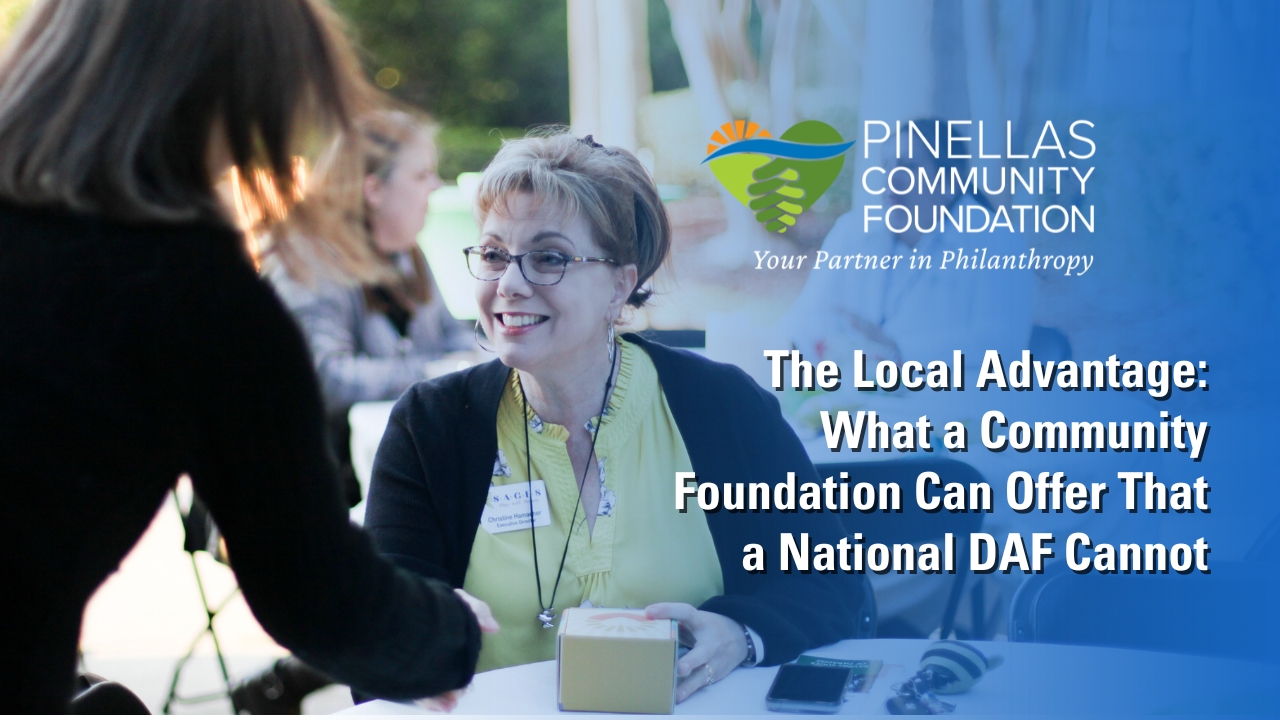
That distinction shows up in small but meaningful ways: a program officer who follows up after a large gift to share how it was used, a phone call before year-end to talk through giving goals rather than just processing a grant request, or a conversation that helps a donor clarify what they’re actually trying to accomplish before they write a check. Clients who’ve only ever used a self-directed platform sometimes don’t realize this level of guidance is available until they experience it, at which point the self-service model can start to feel thin by comparison.
For advisors, this matters because clients don’t always know how to translate “I want to give back” into a coherent giving strategy. A community foundation can do some of that translation work directly, which lightens the advisor’s own load on the philanthropic side of the relationship.
Community Connections a National Platform Can’t Replicate
Community foundations sit at the center of a local giving ecosystem in a way no national sponsor can. They convene donors around shared interests, host briefings on emerging local needs, and often coordinate collaborative funding when a single gift wouldn’t be enough to move the needle on a larger problem.
That matters for clients who want their giving to connect them to something bigger than a single transaction. A donor interested in early childhood education, for example, might be introduced through the community foundation to a handful of other local funders already working on the same issue, turning an isolated gift into a coordinated effort. National platforms have no equivalent mechanism; a grant made through a national DAF simply leaves the account and arrives at a nonprofit, with no connective tissue in between.
Family Engagement Built for the Long Term
Many clients eventually want their children or grandchildren involved in giving decisions, both to pass on values and to make sure a fund has a future beyond the original donor. Community foundations are generally set up to support that transition in ways national sponsors are not.
That can include facilitating family meetings, offering youth or next-generation philanthropy programs, and providing succession planning that keeps a fund active and locally engaged for decades. A national sponsor can technically allow successor advisors on an account, but it typically won’t help a family build the habits, conversations, and shared purpose that make multi-generational giving actually work. For clients thinking about legacy, that structural support can be the deciding factor.
Support for Complex or Unusual Gifts
Not every charitable gift is a simple cash contribution or a transfer of publicly traded stock. Clients with closely held business interests, real estate, complex trusts, or other non-liquid assets often need more hands-on guidance than a standardized national platform is built to provide.
Community foundations, particularly larger ones, frequently have in-house expertise or established relationships with professionals who can help structure these gifts properly, coordinate with a client’s attorney or accountant, and manage the practical steps of valuing and liquidating unusual assets. This kind of support tends to be more available, and more personal, at a community foundation than through a national sponsor’s standardized intake process.
Where This Leaves the Advisor
None of this makes a community foundation the right choice for every client. Plenty of donors are well served by the speed, low cost, and independence of a national platform, and that’s a legitimate preference, not a shortcoming. But for clients whose giving has grown more local, more relational, or more complex than it was when they first opened a DAF, a community foundation offers something a national sponsor structurally cannot: a partner who knows the community, knows the family, and is positioned to stay involved for the long run.
Connect with Pinellas Community Foundation. Call Meg Lokey, Vice President of Philanthropy, at 727-306-3142 or contact her online.
This content is provided for general educational purposes only and does not constitute tax, legal, or financial advice. Figures, limits, and rules referenced are current as of the publication date and are subject to change. Please consult a qualified tax or legal professional before applying this information to a specific client situation.