Three times a day, every day, the Food Center at Vincentian CARES (formerly St. Vincent de Paul CARES) serves meals to neighbors experiencing homelessness and hunger in downtown St. Petersburg. Since 2019, Pinellas Community Foundation (PCF) has supported that work and the housing services built around it. Eleven grants and over $670,000 in support later, the partnership has kept a kitchen running through a pandemic, put a refrigerated truck on Pinellas County roads, and helped older neighbors move from shelter into homes of their own.
Keeping the Kitchen Open
Incorporated in 1985, Vincentian CARES follows a Housing First approach: help people move into permanent housing quickly, without readiness requirements, and connect them to the support they need to stay housed. The Food Center, attached to the CARE Center and Center of Hope shelters, is part of that work.
When COVID-19 arrived in 2020, the volunteer groups that typically provided evening meals stepped back and food donations dropped, just as more people needed help. Vincentian CARES kept its doors open. Support through the Tampa Bay Resiliency Fund helped cover what staying open required: spaced-out bedding in the shelter, protective equipment and cleaning supplies, portable restrooms, and steady pay for Community Thrift Store staff, who were reassigned to its home office and centers while the store was closed. That funding reached 869 people.
Later that year, the Pinellas CARES Nonprofit Partnership Fund sustained the Food Center through December 2020, including a rented freezer and refrigerator trailer to store additional food. That added cold storage made room for donated turkeys and helped staff hand out 102 Thanksgiving baskets and 42 Christmas baskets. In October 2020 alone, the Food Center served 8,607 people through this support.
A Truck Built for Recovery
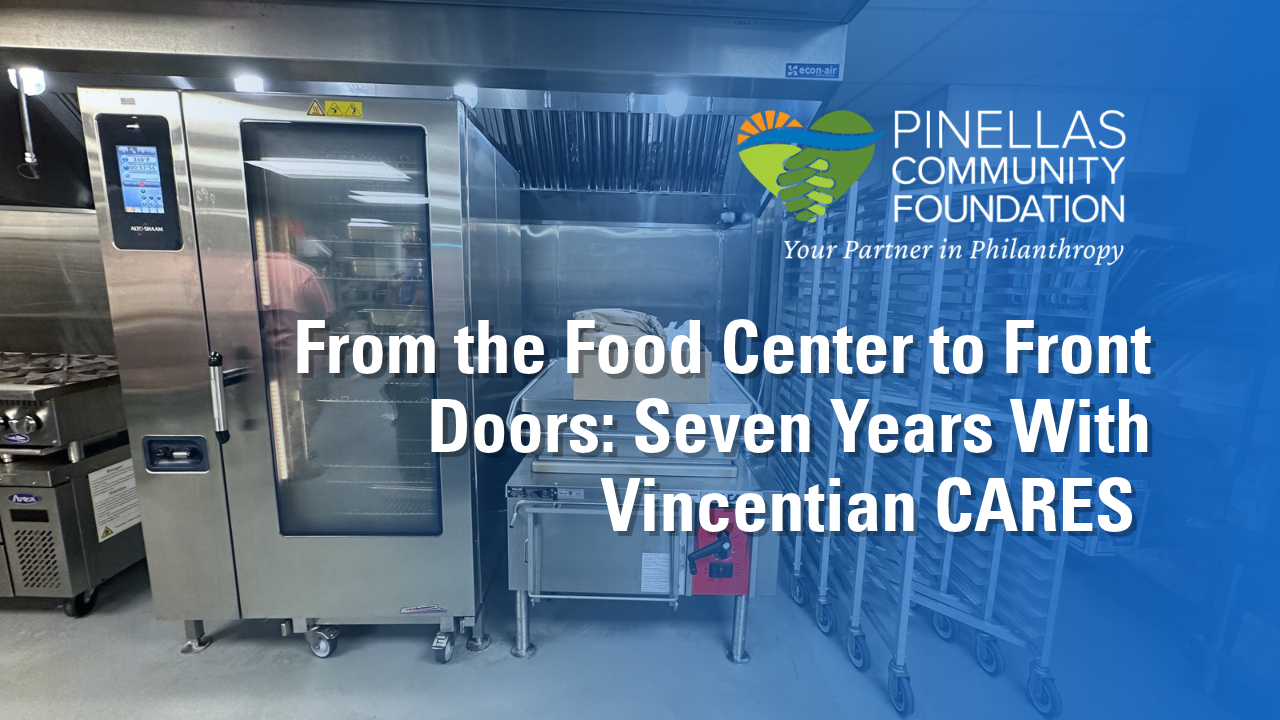
Vincentian CARES’ only transport van wasn’t refrigerated and was mostly used for Community Thrift Store deliveries, limiting how much donated food the Food Center could bring in. Federal recovery funds* helped the organization purchase its own refrigerated truck, along with freezer racks, service carts, a steam table, food warmers, steam pans, pantry shelving, and lockers where guests can store their belongings while they eat.
The truck lets staff transport more perishable donations, like meat and produce, which are healthier and in higher demand than shelf-stable items. It also brought back regular donation pickups from local restaurants and grocery stores, a support stream that had declined during the pandemic.
Then came Hurricanes Helene and Milton in 2024. Food insecurity surged as many households lost power and all of their refrigerated food. Vincentian CARES secured emergency funding for additional food, and the truck’s storage helped staff meet the surge in need. One man fostering nine children lost power and struggled to keep them fed. The Food Center provided enough food to support his family, and he shared how much that stability meant for the children.
Ready Before the Next Storm
The storms also showed how much is at stake for people who were recently housed: without emergency supplies, a single storm can put a new home at risk. Through the Tampa Bay Resiliency Fund, Vincentian CARES purchased 2,000 hurricane kits. Case managers distributed them to 6,000 people across five counties, including Pinellas County, along with storm preparation instructions and information on local shelters and resources. In a follow-up survey, 95% of participants reported being satisfied with the kits.
Steady Support Behind the Scenes
Not every grant is as visible as a truck. General operating support in 2019–20 and 2022–23 gave Vincentian CARES flexible funding for its housing work across Pinellas County. Capital grants purchased equipment to modernize the security camera system at its 15th Street North facility, along with defibrillators and bed bug heaters to protect the health and safety of residents at the Center of Hope.
During the 2022–23 grant period, 80% of participants who left the organization’s Rapid Rehousing program in Pinellas County moved on to a positive housing situation. At the CARE Center, 69% of residents who worked with a housing case manager moved from the shelter into housing.
Eddie’s story shows what that looked like. He left his full-time job to care for his wife, Julia, after she was diagnosed with multiple sclerosis. Side jobs couldn’t build savings, and when their landlord abruptly declined to renew their lease, the couple lost their home. Eddie found a place for Julia in a state-run healthcare facility, but not one for himself. He spent his days by her side and his nights on the street.
Then Eddie found the CARE Center. “I had a safe place to sleep and get off the streets,” he said. One evening, Eddie collapsed, and a CARE Center team member performed CPR until paramedics arrived. He returned a few days later with what he called a “second chance.” With reuniting with Julia as his motivation, he worked through his housing plan with his case manager. Within a month, he was housed. “For the rest of my life, I will be grateful,” Eddie said.
Opening Doors for Older Neighbors
Vincentian CARES has seen a growing number of people age 55 and older seeking emergency shelter. Many live on fixed incomes that can’t cover upfront costs like security deposits and application fees.
In 2025, a Senior Citizens Services grant through PCF funded Rapid Resolution for Homeless Seniors, covering those move-in costs. The goal was to help 10 people. Instead, 15 people moved from homelessness into stable housing, all of them over 55 and eight over 65. Some moved into assisted living, some into permanent independent housing, and some reunited with family in stable homes. One couple who had been separated in a co-ed shelter moved into their own apartment and are living together again.
JP, a retired police officer, lost everything in the 2024 hurricanes, and major medical issues drained his savings. He arrived at the shelter in St. Petersburg with nowhere else to go. Rapid Resolution covered his move-in costs, and he settled into a new, secure apartment. After moving in, JP began volunteering every week at the Food Center, the same kitchen that serves three meals a day to neighbors still finding their way home.
That work continues: a 2026 Senior Citizens Services grant is supporting Rapid Resolution for Homeless Seniors through March 2027.
What Comes Next
Federal recovery funds* are also supporting a larger project now in progress: new air conditioning, renovated restrooms and corridors, and secure new entry doors at the CARE Center, the housing-focused shelter where people sleep, shower, eat, and get help finding a home. The project also includes improvements at the Community Thrift Store, which supplies furniture and household goods to people moving into housing.
Like every grant before it, this project is about meeting people where they are. Partnership is showing up when the volunteer meal groups stepped back, when the power went out, and when a security deposit stood between someone and a home. For seven years, PCF and Vincentian CARES have shown up for Pinellas County neighbors, and the work is far from finished.
—
Inspired by what is possible in Pinellas County? Learn how to establish a fund at Pinellas Community Foundation and put your giving to work: pinellascf.org.
—
* Federal recovery funds refers to the ARPA Nonprofit Capital Project Fund.