In 2018, one donor asked a simple question: what if you invested in nonprofits the way venture capitalists invest in startups — with real money, real trust, and none of the fine print?
That question became the Social Opportunity Works (SOW) Fund, one of Pinellas Community Foundation’s most distinctive grantmaking programs. Originally launched as the Venture Philanthropy Fund and later known as the Social Justice Fund, SOW was built on a premise borrowed from the business world: back people closest to the problem, give them the resources to move, and get out of the way.
Eight years later, that bet has paid off for more than 60 nonprofits across Tampa Bay, with over $1.8 million awarded to organizations working in some of the region’s most under-resourced neighborhoods — ZIP codes 33701, 33705, 33711, 33712, 33713, 33714, and 33755 among them.
The Case for Trusting Nonprofits First
The organizations SOW serves are, by design, small. National Council of Nonprofits data shows that 88 percent of nonprofits operate on less than $500,000 a year, and more than half file the simplified 990-N tax form, meaning their receipts fall under $50,000 annually. These are the organizations doing hands-on community work with the thinnest margins and the least access to traditional philanthropic capital.
Conventional grantmaking often asks the most of the organizations that can least afford it: lengthy applications, restricted funding, and reporting requirements that pull staff time away from mission-critical work. SOW was built to do the opposite, adopting what’s now known nationally as trust-based philanthropy. In practice, that means multi-year, unrestricted funding; PCF taking on the work of getting to know grantees rather than requiring them to prove themselves through paperwork; and open, two-way communication where nonprofits are asked for feedback, not just asked to report outcomes.
For PCF, that shift changed more than a single fund. Adopting trust-based practices has deepened the foundation’s understanding of community needs, informed how other PCF grant programs are run, and given fellow donors a model for supporting great organizations more effectively.
What Trust Looks Like on the Ground
Across Pinellas County, that philosophy shows up in very different rooms.
At Cloud Nine Outdoors, it looks like nearly 100 youth and parents from underrepresented Pinellas communities boarding a boat at John’s Pass for a half-day fishing trip — part of a program that has used the outdoors to build confidence and leadership since 2017.
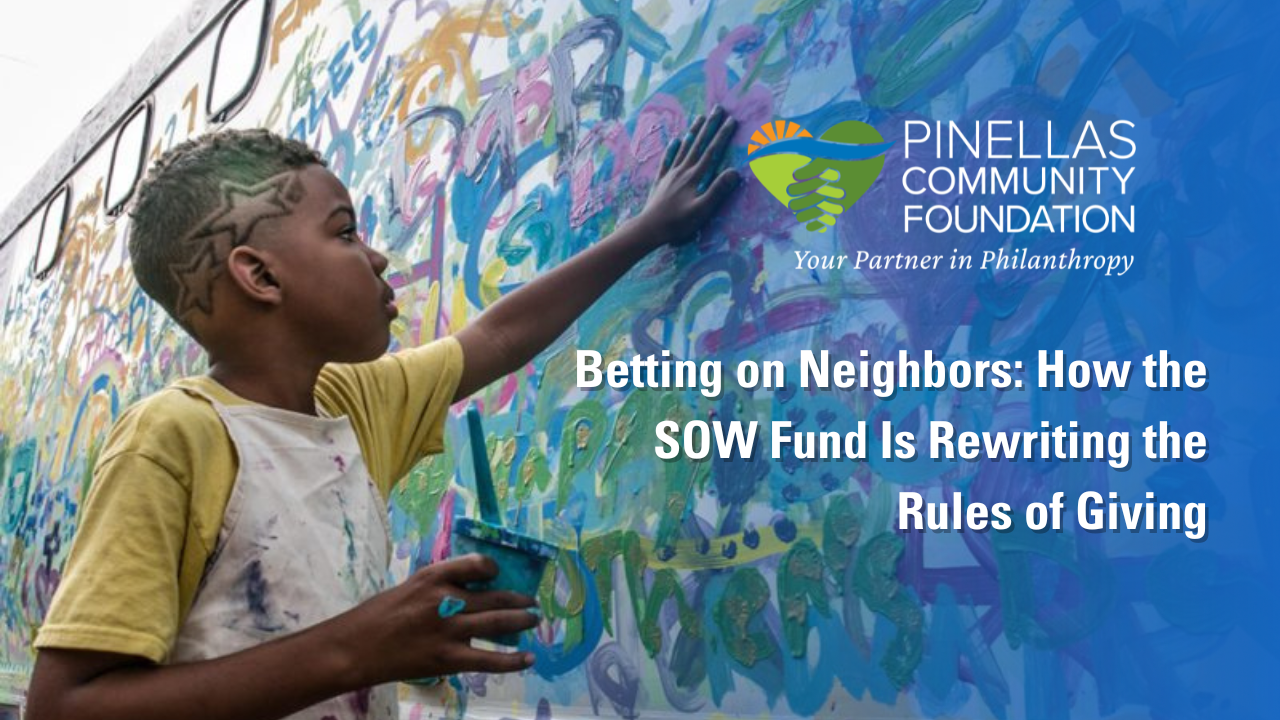
At NOMAD Studio, it looks like an art bus pulling up outside children’s congregate living facilities across the region, bringing monthly pop-up art engagements to 500 to 600 children in the custody of the Florida Department of Children and Families.
At AEDI Foundation, it looks like Super Sprockets STEM Saturdays, where more than 100 children from racially and socioeconomically diverse neighborhoods have built computers, flown drones, and found a version of science that looks like them.
At Shihan School of Survival, it looks like students throughout Pinellas County training in Jujitsu and Karate through the Youth on Track program, using martial arts discipline as a counterweight to youth violence, bullying, and substance use.
And at the Willa Carson Health and Wellness Center, it looks like a season of “Lunch and Learn” programs in Clearwater’s North Greenwood community, giving seniors tools to manage chronic illness — an extension of the more than 50,000 medical visits the center has provided to uninsured and underserved residents since 2005.
Different missions, same throughline: organizations that know their neighborhoods better than any funder ever could, given the flexibility to act on that knowledge.
Why It Matters Beyond the Fund
SOW’s model has always been about more than the dollars. Alongside funding, the fund has offered support with marketing and communications, program design, board development, and financial accountability — the kind of capacity-building that rarely shows up in a grant report but often determines whether a small nonprofit can grow into a stable one.
That’s the quieter argument trust-based philanthropy makes: that the fastest way to strengthen a community isn’t to fund more oversight, but to fund more capacity — and trust the people already doing the work to know what comes next.
To support the SOW Fund and help extend trust-based philanthropy to more Tampa Bay neighborhoods, visit www.pinellascf.org/sowfund
Pinellas Community Foundation is a 501(c)(3) nonprofit organization. A copy of the official registration and financial information for Pinellas Community Foundation (CH3646) may be obtained from the Division of Consumer Services by calling toll-free within the state 800-435-7352 or visiting www.FDACS.gov. Registration does not imply endorsement, approval, or recommendation by the state. Your gift may be tax-deductible; please consult your tax professional to explore your benefits.